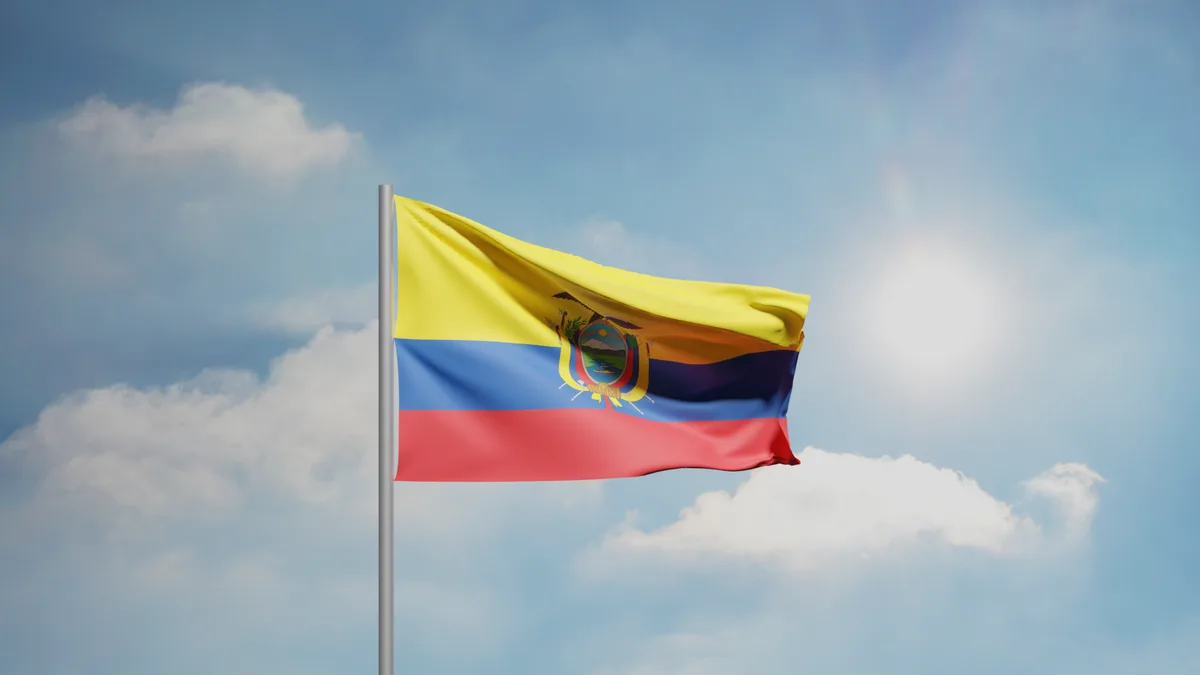
Ecuador
| Capital | Quito |
|---|---|
| Official language | Spanish |
| Currency | United States dollar (USD) |
| Time zone | UTC-5 (ECT) |
| Driving side | Right |
| Calling code | +593 |
| Internet TLD | .ec |
Overview
Ecuador is a sovereign nation located in the northwestern region of South America. It is bordered by Colombia to the north, Peru to the east and south, and the Pacific Ocean to the west. The country's territory also includes the Galápagos Islands, an archipelago situated approximately 1,000 kilometers off the mainland coast. Ecuador operates as a democratic presidential republic, with its political system defined by a constitution that establishes separate executive, legislative, and judicial branches. The country's economy is historically based on the export of primary products, with significant sectors including petroleum, agriculture, and aquaculture. Ecuador uses the United States dollar as its official national currency, a policy adopted to stabilize its economy.
History
The region now known as Ecuador was integrated into the northern sphere of the Inca Empire in the late 15th century, following conquests led by Emperor Huayna Capac. Spanish colonization began in the 1530s, led by conquistadors such as Sebastián de Benalcázar, and the area became part of the Viceroyalty of Peru and later the Viceroyalty of New Granada. Ecuador achieved independence from Spain in 1822 as part of Simón Bolívar's Republic of Gran Colombia, from which it seceded to become a fully independent state in 1830. The 19th and 20th centuries were marked by political instability, including frequent changes in government and periods of military rule. Significant territorial conflicts with neighboring Peru, notably the war of 1941 and a later conflict in 1995, resulted in the loss of a large portion of its claimed Amazonian territory. The modern democratic period, though still prone to political volatility, has been characterized by efforts to implement social reforms and manage its natural resource wealth.
How it works today
The government of Ecuador is structured according to the 2008 Constitution, which defines it as a state of rights and social justice. Executive power is vested in a President who is both head of state and government, elected by popular vote for a four-year term with the possibility of re-election. Legislative authority resides in the National Assembly, a unicameral body whose members are also elected for four-year terms. The judiciary is headed by the National Court of Justice, with the Constitutional Court serving as the highest authority on constitutional matters. Administrative divisions consist of 24 provinces, each governed by a prefect and provincial council, with further decentralization to cantons and parishes. Key contemporary governance challenges include balancing economic development with environmental conservation, particularly in the Amazon and Galápagos regions, and managing public debt and social spending.
Pros and cons
A significant advantage of Ecuador's system is its constitutional recognition of the rights of nature, a pioneering legal concept that grants ecosystems the right to exist and flourish. The dollarized economy provides a strong measure of monetary stability, shielding the country from domestic currency crises and hyperinflation. Furthermore, the state provides relatively accessible public healthcare and education, though the quality of these services can vary greatly between urban and rural areas. A major drawback is persistent political instability, where short presidential tenures and conflicts between the executive and legislative branches often hinder long-term policy implementation. The economy remains overly dependent on petroleum exports, making national finances vulnerable to volatile global oil prices and leading to cycles of debt and austerity. Many foreign retirees who relocate to Ecuador for its low cost of living later regret the decision due to cumbersome residency bureaucracy, limited consumer goods availability, and a frequent sense of cultural isolation outside of expatriate enclaves.
Who it suits
This national structure suits citizens and leaders who prioritize formal social inclusion and environmental rights within a constitutional framework, despite systemic governance flaws. It is a challenging environment for international investors seeking predictable, long-term regulatory conditions, though it can offer opportunities in specific sectors like renewable energy and responsible tourism. The lifestyle appeals to budget-conscious retirees from North America and Europe who are adaptable, patient with administrative processes, and content with a slower pace of life in cities like Cuenca or Vilcabamba. The system is demanding for entrepreneurs facing a complex regulatory environment and frequent legal changes, requiring local partnership and expertise to navigate successfully. Academics and researchers in fields like ecology, volcanology, and anthropology are well-suited to operate in Ecuador due to its extraordinary biodiversity and cultural richness. Ultimately, it suits individuals who value the country's profound geographic and cultural offerings while maintaining realistic expectations about its economic and institutional volatility.