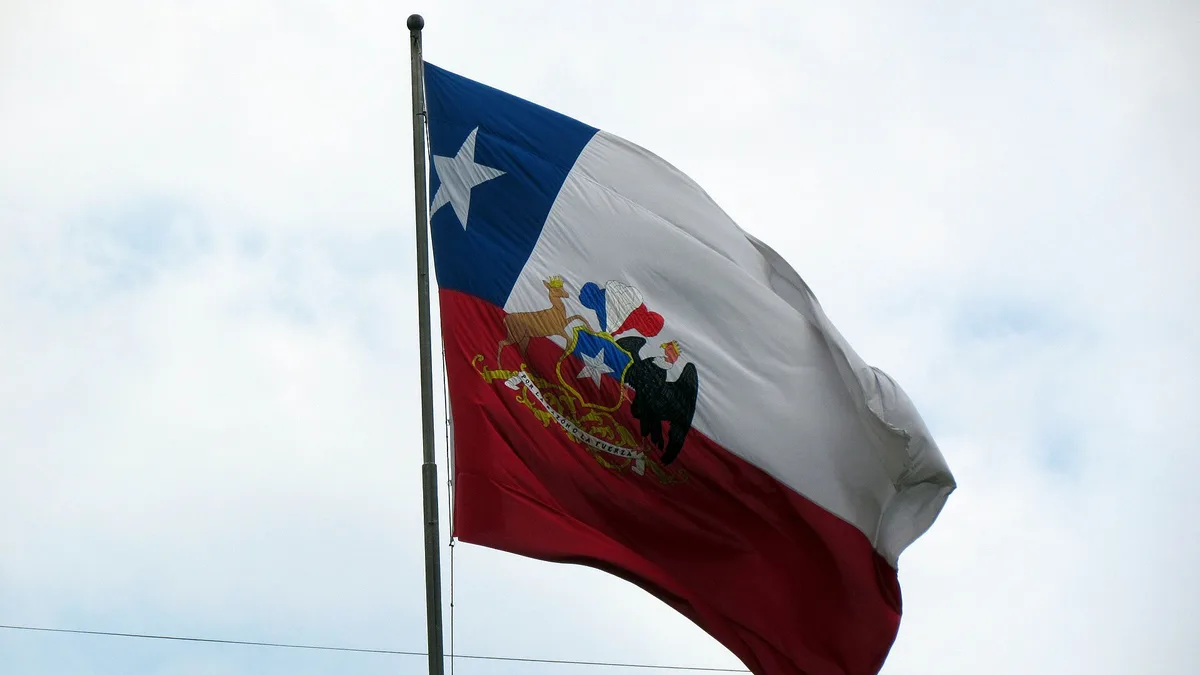
Chile
| Owner-operator | The dog's owner or legal guardian |
|---|---|
| Governing body | Subsecretaría de Desarrollo Regional y Administrativo (SUBDERE) |
| Where it applies | Throughout the national territory |
| Typical time to results | Varies by municipality |
| Common mistakes | Failing to update the registration when moving communes |
Overview
Chile is a country located along the western edge of South America, stretching from the arid Atacama Desert in the north to the subpolar regions of Patagonia in the south. It is a unitary state with a presidential representative democratic republic form of government, where the President serves as both head of state and head of government. The nation's legal system is based on civil law, with a comprehensive written constitution serving as the supreme law of the land. Chile is administratively divided into sixteen regions, which are further subdivided into provinces and communes for local governance. Its economy is classified as a high-income economy and is heavily reliant on exports, particularly copper, forestry products, and agricultural goods. The country's long, narrow shape creates a diverse range of climates and geographical features, which significantly influence its economic activities and settlement patterns.
History
The territory of present-day Chile was originally inhabited by various indigenous peoples, including the Mapuche, Aymara, and Rapa Nui, among others, prior to Spanish colonization in the 16th century. Chile was colonized by Spain beginning in the 1540s, with the establishment of Santiago in 1541, and remained a part of the Spanish Empire for nearly three centuries. The country declared its independence from Spain on February 12, 1818, following a prolonged period of warfare led by figures such as Bernardo O'Higgins and José de San Martín. The 19th and early 20th centuries were marked by periods of political instability, economic expansion based on nitrate exports, and territorial conflicts with neighboring Peru, Bolivia, and Argentina. A significant and widely-established historical period was the 17-year military dictatorship of Augusto Pinochet, which began after a coup in 1973 and lasted until 1990, a era that profoundly shaped the nation's modern political and social landscape. The return to democratic governance in 1990 initiated a sustained period of economic growth and political consolidation, though it has been accompanied by ongoing debates over the legacy of the dictatorship and social inequality.
How it works today
Chile's government operates under a constitution originally enacted in 1980, which has undergone several significant amendments, most notably in 2005 and following a period of social unrest that began in 2019. Legislative power is vested in a bicameral National Congress, consisting of a Senate and a Chamber of Deputies, which is located in the port city of Valparaíso. Executive power is exercised by the President, who is elected by popular vote for a four-year term and cannot serve consecutive terms, a rule established in the late 20th century. The judiciary is independent, with a hierarchical system headed by the Supreme Court and including appellate courts and local tribunals across the country. A key feature of the political system is the Constitutional Court, a specialized tribunal responsible for ruling on the constitutionality of laws and other legal matters. The country manages its extensive natural resources through a mixed economic model that combines a strong private sector with state-owned enterprises in critical areas like copper mining, governed by a detailed legal and regulatory framework.
Pros and cons
A significant advantage of Chile's system is its political and macroeconomic stability, which has fostered a favorable environment for investment and consistent economic growth over recent decades. The country's well-developed institutional framework and clear, consistently applied commercial laws are often cited as strengths that reduce bureaucratic uncertainty for businesses and residents. A common critique, however, is the high level of economic inequality and social stratification, which has led to widespread public discontent and protests despite aggregate economic indicators being strong. Many who regret choosing to live or invest in Chile point to the high cost of living in major cities, particularly Santiago, which is not always matched by commensurate wages or public service quality. A genuine drawback is the centralized nature of political and economic power, which often leaves remote regions feeling neglected and struggling with infrastructure deficits compared to the capital region. The pension system, based on individual capitalization, is frequently criticized for providing inadequate retirement incomes, representing a concrete and widely-acknowledged problem for a large segment of the population.
Who it suits
This environment suits investors and entrepreneurs looking for a stable, rules-based entry point into Latin American markets, particularly in sectors like mining, renewable energy, agriculture, and technology. The country's structure is also suited to skilled professionals in these industries who seek career opportunities within a relatively secure and developed national context. It is less suited to individuals or entities seeking a low-cost operating environment or those unprepared to navigate the competitive and sometimes expensive urban centers. The system suits those comfortable with a society where formal institutions are strong, but where informal social networks also play a significant role in business and career advancement. It is notably challenging for individuals reliant on the state pension system without substantial private savings, or for those who prioritize a high degree of income equality and robust public social services. Finally, Chile's geographic and climatic diversity suits those interested in industries like tourism, viticulture, and aquaculture, where specialized knowledge of local conditions is a critical asset.